Not All Kraft Paper Performs the Same Job: Matching Grade to Application

When paper buyers compare suppliers, the conversation often starts with price, GSM, strength, brightness, or other measurable specifications.
But there is another factor that can have an equally significant impact on the buyer’s operation:
Consistency.
A paper specification can look perfect on a datasheet and still create problems if the material does not perform consistently from one batch to another.
For manufacturers and converters, consistency affects far more than the appearance of a paper reel. It can influence machine settings, converting performance, print quality, packaging strength, production efficiency, inventory planning, and ultimately the reliability of the finished product.
This is why manufacturing consistency is increasingly becoming a competitive advantage in the paper industry.
A reliable paper manufacturer is not simply producing paper that meets a specification once. The objective is to produce paper that repeatedly meets the required specification across production runs.
Paper consistency is not a single measurement.
It refers to the ability of a manufacturer to maintain important properties within defined tolerances throughout production and across different batches.
Depending on the application, these properties can include:
The importance of each property changes according to the application.
A paper used for commercial printing may require particular attention to formation, surface characteristics, brightness, and moisture.
A kraft paper used for packaging may place greater emphasis on strength, moisture, stiffness, formation, and runnability.
The important point is that consistency is application-specific.
A good paper specification therefore cannot be separated from the process in which the paper will ultimately be used.
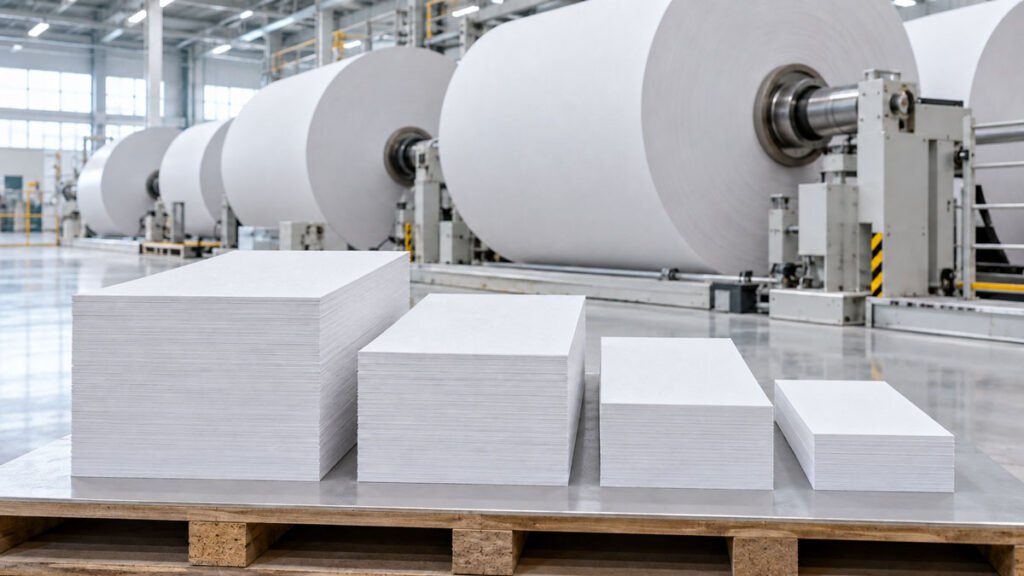
The final paper reel is the visible result of a much longer manufacturing process.
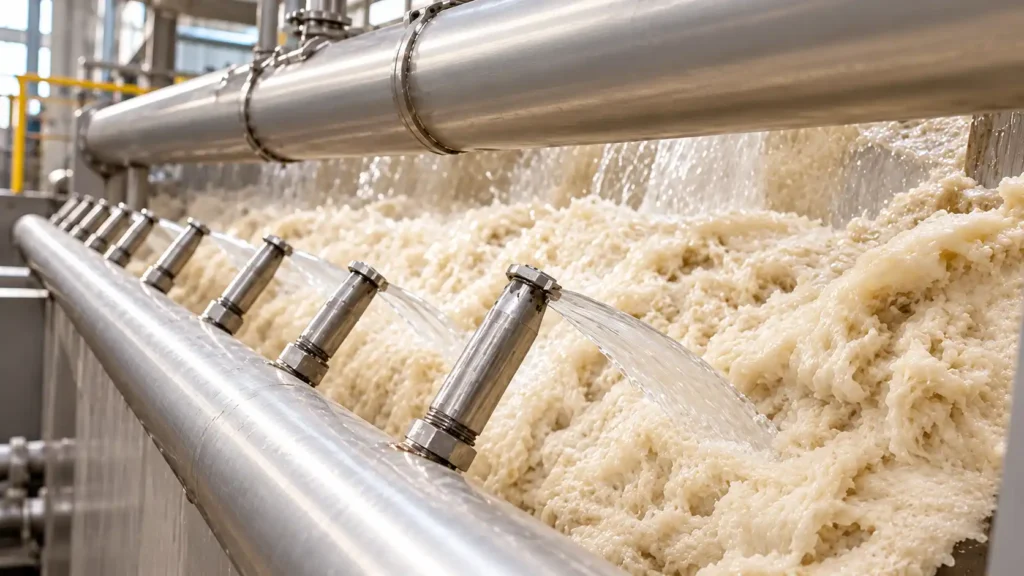
Consistency begins with the preparation of raw materials and continues through stock preparation, fibre treatment, sheet formation, pressing, drying, finishing, winding, and quality control.
Small changes in one stage can influence what happens later.
For example, differences in fibre preparation can influence formation. Variation in formation can affect how a sheet interacts with ink, moisture, or mechanical stress. Drying conditions can influence moisture profiles and dimensional behaviour.
Modern paper manufacturing therefore relies heavily on measurement and process control.
Industrial paper-machine quality systems can monitor parameters such as grammage and moisture profiles across the sheet. Manufacturers use these measurements to identify variation and make process adjustments rather than relying only on final inspection.
This distinction is important.
Quality control is not simply about finding defective paper. It is about controlling the process that produces the paper.
Imagine a packaging manufacturer receives a paper grade that performs well during the first production run.
The machine settings are established.
The converting process is tuned.
The finished packaging meets expectations.
The next shipment arrives and the material behaves differently.
Even if the difference is small, the manufacturer may need to adjust machine settings, change process parameters, increase inspection, or deal with higher rejection rates.
This creates hidden costs.
The problem is not necessarily that the second batch is “bad” paper.
The problem is that the buyer has lost predictability.
For high-volume manufacturing, predictability has considerable value.
A converter needs to know that the next reel will behave within the expected operating window.
A printer needs confidence that the next batch will respond similarly on press.
A packaging manufacturer needs confidence that the material will support the same production settings.
That is where manufacturing consistency becomes a commercial advantage.
Paper rarely reaches the end customer directly.
It is often converted into another product.
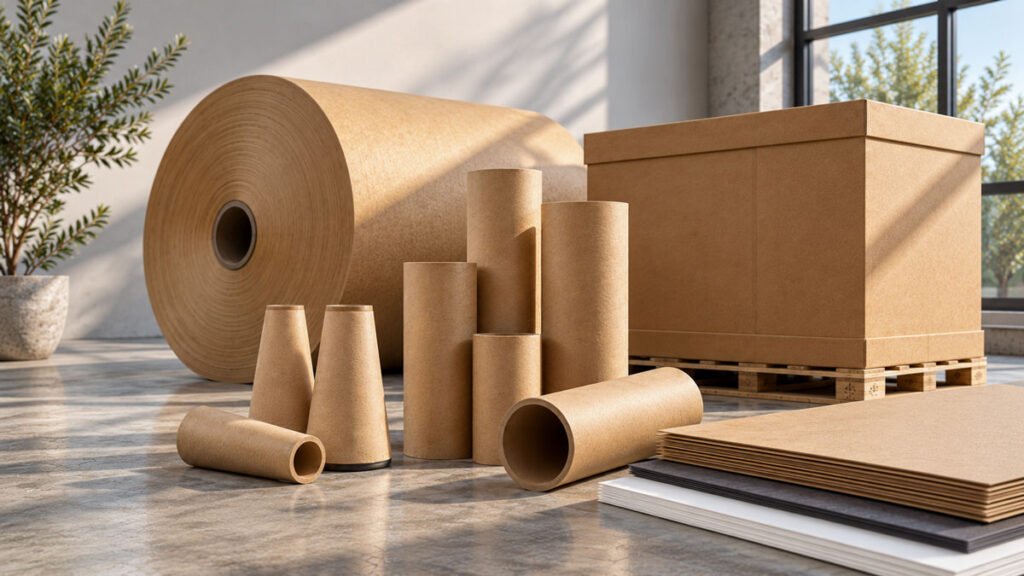
Kraft paper may become a corrugated box, sack, bag, or other packaging application.
Printing paper may become a catalogue, book, label, document, or commercial publication.
Value added paper may become food service products, specialty packaging, or other converted applications.
At each stage, the paper must interact with machinery.
Variation in physical properties can influence how material feeds, folds, cuts, prints, bonds, or handles during conversion.
Technical literature from the paper industry highlights the relationship between stable paper properties, profile control, runnability, and downstream performance. Dimensional stability issues, for example, can contribute to problems such as curl, web shrinkage, waviness, and converting rejects.
This means that paper quality should not be evaluated only by looking at the reel.
It should also be evaluated by asking:
How predictably will this material behave in my process?
For a small production run, a variation may be manageable.
For a high-volume production environment, the same variation can become expensive.
Consider a converter running continuously for several shifts.
If paper behaves differently from one reel to another, operators may have to make repeated adjustments.
Those adjustments can consume:
There may also be downstream costs if inconsistent material results in rejected or downgraded finished products.
This is why larger industrial buyers increasingly evaluate suppliers not only on the specification of the paper but also on the supplier’s ability to reproduce that specification reliably.
There is another advantage that is harder to measure but extremely important.
Confidence.
When a buyer has repeatedly received material that performs predictably, procurement becomes easier.
The buyer knows what to expect.
Production teams know how the material behaves.
Quality teams have established benchmarks.
Converters do not need to repeatedly requalify the same material.
This reduces uncertainty throughout the supply chain.
For long-term B2B relationships, that predictability can be more valuable than a small difference in the initial purchase price.
International buyers face an additional challenge.
The paper may travel thousands of kilometres between the manufacturer and the end user.
The buyer may not have direct visibility into the manufacturing process.
The material may pass through ports, warehouses, distributors, and multiple handling points before reaching production.
This makes specification discipline and quality documentation particularly important.
For international procurement, buyers should look beyond a product brochure and ask:
These questions help distinguish a manufacturer that can supply a specification from one that can reliably manufacture to it.
A practical evaluation does not need to be complicated.
Start with five areas.
Tell the manufacturer exactly how the paper will be used.
The relevant quality parameters depend on the application.
Do not evaluate every property equally.
Identify the characteristics that directly affect your process.
Laboratory measurements are useful, but production trials provide additional information about runnability and conversion performance.
A single sample demonstrates that a paper can perform.
Multiple batches provide a better indication of whether performance is repeatable.
Ask how the manufacturer controls variation during production rather than only how the final product is inspected.
The paper industry is becoming increasingly demanding.
Buyers want competitive pricing, but they also want fewer surprises.
Converters want higher productivity.
Printers want predictable performance.
Packaging manufacturers want stable converting behaviour.
Importers want reliable repeat supply.
These requirements all point toward the same underlying need:
Consistency.
A paper manufacturer that can repeatedly produce material within the required specification gives its customers something more valuable than a good sample.
It gives them predictability.
And in industrial manufacturing, predictability has a direct commercial value.
The strongest paper supplier is therefore not necessarily the one that produces the most impressive individual reel.
It is the one that can produce the expected result again, and again, and again.
At KR Papers, manufacturing consistency is approached as a process requirement rather than a final inspection exercise.
Our paper portfolio spans writing and printing paper, copier paper, kraft paper, pulp, and value added paper, serving different industrial applications with different performance requirements.
The objective of a paper manufacturer is not simply to produce material that looks right when it leaves the mill.
It is to manufacture material that performs predictably when it reaches the customer’s process.
For buyers evaluating paper suppliers, that is one of the most important questions to ask:
Can this supplier deliver the same performance tomorrow that it delivered today?
That is where manufacturing consistency becomes a competitive advantage.
At KR Papers, we craft premium, eco-friendly paper solutions that blend quality, innovation, and sustainability to meet diverse customer needs.

© 2026 KR Pulp and Papers Limited. All rights reserved.
WhatsApp us