Not All Kraft Paper Performs the Same Job: Matching Grade to Application

“Kraft paper” sounds like one material.
In industrial manufacturing, it is better understood as a family of papers designed around different requirements.
A sheet used as a corrugated liner does not necessarily need the same characteristics as paper used for yarn cone winding.
A heavy-duty export carton has different performance requirements from an industrial winding application.
That is why kraft paper grades should be selected by application, not simply by the word kraft on a specification sheet.
The most useful question when selecting kraft paper is not:
“What GSM should we buy?”
It is:
“What does the finished application need the paper to do?”
The answer could involve compression strength, burst performance, stiffness, dimensional stability, winding behaviour, absorbency, printability or converting performance.
Once that requirement is clear, the paper grade becomes easier to specify.
This application-first approach is the foundation for understanding kraft paper grades.
Test Liner is intended for corrugated packaging applications.
KR Papers lists the grade in the 120 to 180 GSM range and highlights high crush strength, consistent formation, moisture balance and a smooth printing surface.
Its listed end uses include corrugated boxes, e-commerce cartons, retail packaging and industrial shipping containers.
The paper therefore has to function as part of a larger corrugated structure while also supporting the printing and presentation requirements of the finished box.
HRCT stands for High RCT Kraft.
The grade is positioned around exceptional Ring Crush Test performance, high burst index, stiffness and a smooth printable surface.
It is intended for heavy-duty corrugated cartons, industrial sacks, export boxes and multi-ply kraft boards.
Here, compression performance becomes particularly important because packaging may face stacking and handling loads.
The relevant question is therefore not whether the paper is simply strong.
It is what type of force the packaging needs to withstand.
DTY/POY kraft paper illustrates why kraft paper grades can be so different even when they belong to the same broad category.
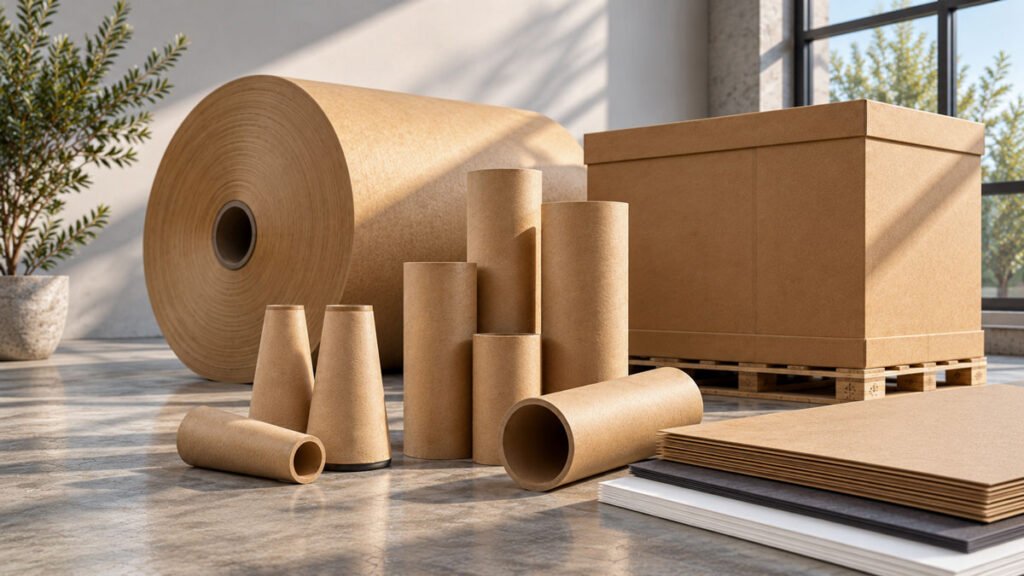
This grade is designed for textile and winding applications including yarn cone and tube winding, separator sheets, bobbin wrapping, reel interleaving and textile packaging.
The operating conditions are very different from those of a corrugated shipping carton.
The paper may need to handle continuous winding, tension, friction and mechanical movement.
That changes which characteristics matter most.
Absorbent Kraft represents another specialised kraft application.
Here, the paper’s interaction with another material becomes part of the specification.
For saturating and laminate-related applications, absorbency and the way the sheet accepts resin can become critical process considerations.
The paper is therefore being selected for how it behaves during manufacturing, not simply for its appearance as a finished sheet.
The examples above show that kraft paper grades can be engineered around very different performance requirements.
Depending on the application, buyers may care about:
There is no single specification that answers all of these questions.
A useful comparison starts with the application and moves toward the paper properties.
What will the paper become?
A corrugated box, industrial sack, yarn cone, tube, laminate component or another product?
Will it be compressed, stacked, wound, tensioned, folded, converted or laminated?
Is the key requirement RCT, burst, stiffness, absorbency, dimensional stability or another characteristic?
How will the paper be cut, printed, wound, formed or combined with another material?
Only after these questions are answered does it make sense to compare the available kraft paper grades.
GSM is useful.
But it should not become a substitute for understanding the application.
Two papers can have similar basis weight and still behave differently in a production environment.
The finished product does not experience GSM by itself.
It experiences the combined effect of the paper’s structure, properties, converting conditions and application.
That is why buyers should look beyond one number when selecting kraft paper grades.
Kraft paper is not one universal material.
Different applications place different demands on the sheet, which is why kraft portfolios contain different grades designed around different performance requirements.
The better procurement question is not:
“Which kraft paper is strongest?”
It is:
“Which kraft paper grade is designed for the job we need it to do?”
Once that question is answered, the rest of the specification becomes much clearer.
KR Papers
Paper engineered around the application.
At KR Papers, we craft premium, eco-friendly paper solutions that blend quality, innovation, and sustainability to meet diverse customer needs.

© 2026 KR Pulp and Papers Limited. All rights reserved.
WhatsApp us