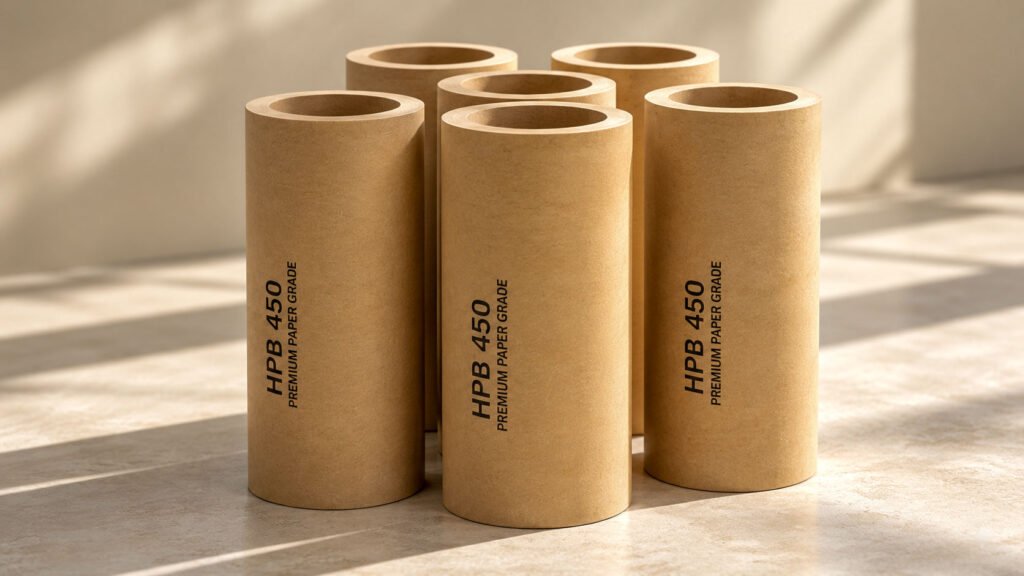
A paper core can look simple from the outside.
Inside an industrial process, it may be supporting substantial weight, dealing with winding forces and maintaining its shape throughout storage and handling.
That is why heavy-duty paper cores require more than a sheet that simply has high GSM.
The paper becomes part of a structural system, and its properties need to match the load and operating conditions of the finished core.
Why Paper Cores Need Structural Performance
Industrial paper cores are commonly used to support rolls, reels and wound materials.
As the diameter, weight and winding tension increase, the forces acting on the core also increase.
A core can experience:
- Compression
- Radial pressure
- Winding tension
- Handling stress
- Stacking loads
A paper core that deforms under these conditions can affect the stability of the roll and the wider production process.
This is why heavy-duty paper cores need to be evaluated as engineered components rather than simple tubes.
Bulk Is Part of the Structure
HPB 450 is a 300 to 450 GSM heavy-duty industrial paper grade from KR Papers.
Its positioning focuses on high bulk, crush resistance, stable winding and resistance to deformation.
These characteristics are relevant when the core itself has to maintain structural integrity under demanding conditions.
But GSM alone does not tell the whole story.
A suitable core paper has to work together with the core’s construction, diameter, wall thickness and operating environment.
Understanding Crush Resistance
Crush resistance becomes especially important when a core is exposed to external pressure.
During storage or handling, the finished roll may experience loads from above or from adjacent material.
During winding, the material around the core can also create forces that act against the core wall.
For heavy-duty paper cores, the ability to resist crushing and deformation can therefore be more important than simply increasing paper thickness.
Where HPB 450 Fits
KR Papers positions HPB 450 for applications including:
- Heavy-duty paper cores and tubes
- Large-diameter winding systems
- Industrial drums
- Load-bearing separators
- Specialised industrial packaging
The common requirement across these applications is structural stability.
Why Winding Stability Matters
The core often operates as part of a continuous winding system.
It needs to remain dimensionally stable while material is being wound around it.
If the core begins to deform, the impact may extend to the material being wound, affecting alignment, handling and downstream operations.
This is why buyers should consider what the paper will experience throughout the process, not only how the paper looks before conversion.
How to Specify Core Paper
A practical procurement conversation should begin with the finished application.
Ask:
- What material will be wound?
- What will the finished roll weigh?
- What winding tension will be applied?
- What core diameter is required?
- How will the roll be stored?
- What loads will occur during handling?
These questions help define the structural requirements of the paper.
For heavy-duty paper cores, the correct specification is the one that connects paper properties with the mechanical demands of the finished product.
Conclusion
A paper core is doing more than holding a roll in place.
It has to maintain its structure while handling compression, winding forces, storage and transport conditions.
That is why the paper used to manufacture heavy-duty paper cores needs to be selected around the actual demands of the application.
HPB 450 is developed for demanding industrial applications where bulk, crush resistance, winding stability and deformation resistance matter.
When the core carries the load, the paper inside it matters.