Understanding Moisture Control in Paper Manufacturing and Why It Matters

Moisture is one of the least visible properties of paper.
You cannot identify the moisture content of a reel simply by looking at it.
Yet moisture can influence how paper behaves during storage, transport, printing, converting, packaging, and machine processing.
For this reason, moisture control is an important part of paper manufacturing and quality management.
The challenge is that paper does not exist in isolation from its environment.
Paper fibres interact with water vapour in the surrounding atmosphere. As environmental conditions change, paper can gain or lose moisture. This can influence dimensions, curl, stiffness, runnability, and other performance characteristics.
In industrial applications, the objective is therefore not simply to produce “dry paper.”
The objective is to produce paper with controlled and appropriate moisture characteristics for its intended application and environment.
Paper moisture content refers to the amount of water contained within the paper relative to its dry material.
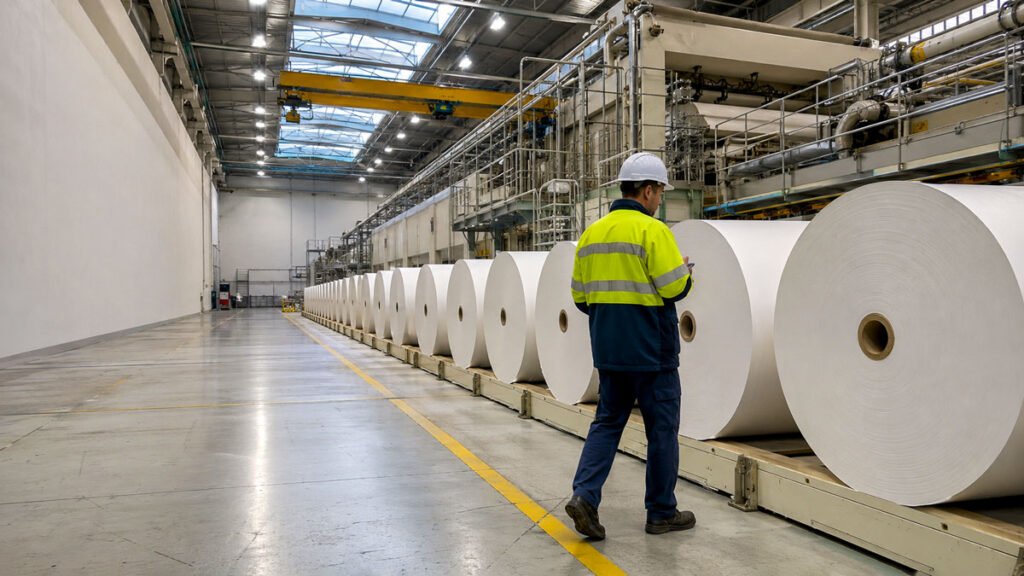
During manufacturing, water is intentionally present in the fibre suspension and must be progressively removed through forming, pressing, and drying.
The drying process is therefore one of the central operations in papermaking.
But drying has to be controlled carefully.
Removing too much moisture or creating uneven moisture distribution can create problems of its own.
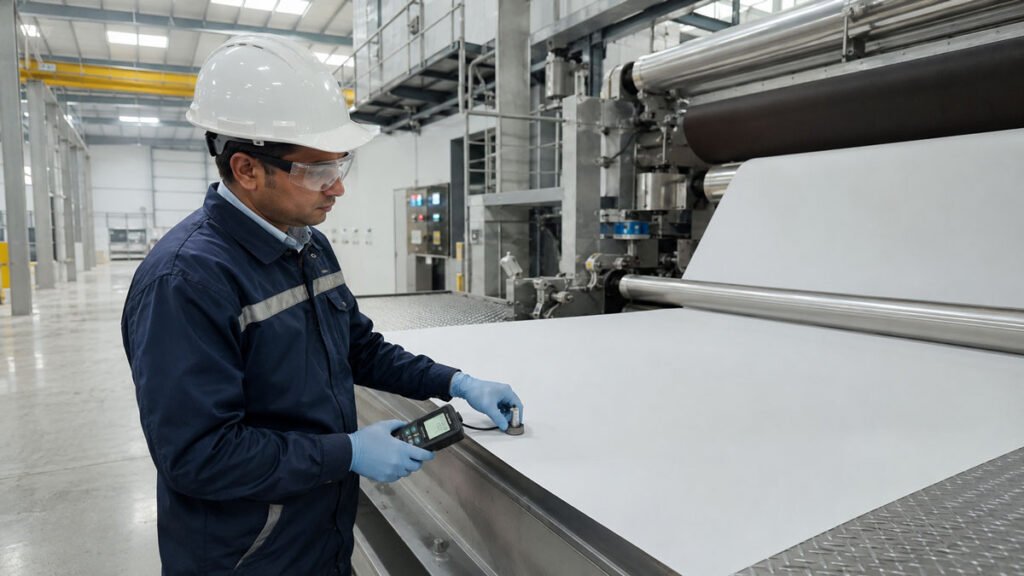
Modern paper machines use measurement and control systems to monitor moisture profiles and maintain more consistent conditions across the paper web.
Paper is a hygroscopic material.
That means it can exchange moisture with the surrounding environment.
If paper is exposed to an environment with higher relative humidity, it can absorb moisture.
In a drier environment, it can release moisture.
This interaction matters because moisture changes can affect the physical dimensions and behaviour of the sheet.
Research published in the Japan TAPPI Journal has examined the relationship between drying shrinkage and the dimensional stability of paper.
In practical terms, this means that moisture is not simply a laboratory specification.
It is a property that can influence how paper behaves throughout its life cycle.
One of the most important reasons to control moisture is dimensional stability.
Paper can expand or contract as its moisture condition changes.
This becomes particularly important when paper is being printed, laminated, converted, folded, die-cut, corrugated, or otherwise processed.
If different areas of a sheet or web have different moisture levels, those areas can respond differently to environmental or process conditions.
This can contribute to problems such as:
Technical work in the paper industry has linked dimensional stability problems with issues including curl, web shrinkage or expansion, waviness, and converting rejects.
Moisture control therefore plays an important role in keeping paper dimensions predictable.
Moisture control starts during manufacturing itself.
The paper web passes through several stages where water is removed.
The forming section begins the dewatering process.
The press section removes additional water mechanically.
The drying section then removes much of the remaining moisture through controlled thermal drying.
Each stage affects the final moisture condition of the sheet.
Poor control in one part of the machine can create variation later.
This is why moisture control cannot be treated as a single end-of-line activity.
It is a process-control issue.
This distinction is often overlooked.
Imagine a paper reel with an acceptable average moisture level.
That sounds good.
But what if one side of the reel is significantly wetter than the other?
The average may still look acceptable.
The paper may not perform consistently across its width.
This is known as a moisture profile issue.
Modern paper quality-control systems measure moisture across the sheet or web rather than relying only on a single average value. Valmet has documented the use of scanners and control systems to improve grammage and moisture profiles in paper production.
The objective is not simply to hit one number.
It is to achieve a stable and uniform profile.
That distinction can be important for high-speed converting and printing applications.
For kraft and packaging papers, moisture can influence how the material behaves during converting and use.
Packaging paper may experience several environmental conditions between the paper mill and the finished package.
It may be:
Every stage can introduce environmental changes.
For packaging applications, moisture can therefore affect dimensional behaviour, stiffness, converting performance, and the interaction between paper components.
In corrugated packaging specifically, moisture is a major factor in dimensional behaviour. Valmet notes that moisture, rather than temperature alone, is a key driver of dimensional changes in fibre-based processes.
This is one reason why moisture management matters beyond the paper mill.
Paper storage conditions can influence moisture equilibrium.
A paper reel stored in a humid environment can behave differently from the same reel stored in a dry environment.
This is particularly important when paper is stored for extended periods or moved between climates.
For buyers and distributors, storage conditions should therefore be considered alongside the original paper specification.
Practical considerations include:
The objective is to prevent unnecessary moisture exchange before the paper reaches the machine.
International paper shipments introduce another variable.
Paper can move between climates with very different temperature and humidity conditions.
A shipment originating in a relatively dry environment may eventually arrive in a humid tropical market.
During transportation and storage, the paper may encounter different environmental conditions.
This makes moisture management particularly relevant for exporters and importers.
For international buyers, it is therefore useful to discuss:
The correct moisture specification is not just a manufacturing decision.
It should be considered in relation to the complete supply chain.
There is no single failure mode.
The outcome depends on the paper grade, application, environmental conditions, and degree of variation.
Potential issues can include:
Changes in moisture can contribute to dimensional changes that affect sheet flatness.
Variation in dimensions or tension can make high-speed converting less predictable.
Moisture-related dimensional changes can affect sheet handling and registration.
Paper exposed to uncontrolled humidity can change its physical behaviour over time.
For packaging papers, environmental moisture can affect the behaviour of the finished packaging system.
The important point is that moisture problems often become visible downstream, even though the underlying cause may originate much earlier.
A manufacturer cannot reliably control what it does not measure.
Modern paper mills use measurement systems to monitor moisture and other critical paper properties throughout production.
This reflects a broader shift in paper manufacturing.
Quality is increasingly managed through continuous process information rather than final inspection alone.
For buyers, this raises an important question:
How does your paper supplier measure and control moisture?
When moisture is important to the application, buyers should consider asking:
These questions help move the conversation from a simple product purchase toward application-specific quality management.
The goal of moisture control is not to remove every last trace of water from paper.
The goal is to produce a stable material with moisture characteristics appropriate for its intended application and supply chain.
For manufacturers, that means controlling drying and moisture profiles during production.
For buyers, it means specifying the right requirements.
For distributors, it means protecting the material during storage.
For converters, it means understanding how the paper will behave under actual production conditions.
When all of these factors are considered together, moisture becomes much more than a number on a test certificate.
It becomes part of the paper’s performance.
When evaluating a paper supplier, moisture content should be considered alongside other important specifications such as GSM, strength, formation, surface properties, and dimensional stability.
A paper that meets its target moisture specification at the mill still needs to be stored, transported, and processed appropriately.
That is why the best approach is to consider moisture across the entire supply chain.
At KR Papers, moisture is one of the parameters considered within the broader manufacturing and quality-control process across our paper portfolio. Our products serve different applications, including writing and printing, copier, kraft, and value added paper, each with its own performance requirements.
For buyers, the practical takeaway is simple:
Do not ask only whether a paper meets a moisture specification. Ask whether its moisture behaviour is appropriate for your application, process, storage conditions, and destination market.
That is where moisture control becomes a meaningful part of paper quality.
At KR Papers, we craft premium, eco-friendly paper solutions that blend quality, innovation, and sustainability to meet diverse customer needs.

© 2026 KR Pulp and Papers Limited. All rights reserved.
WhatsApp us