Why Manufacturing Consistency Is Becoming a Competitive Advantage in Paper Production

If you buy paper professionally, whether for printing, packaging, stationery, or industrial use, you encounter the term GSM in almost every product description and specification sheet. It is one of the most important numbers in paper procurement. It is also one of the most commonly misunderstood.
This guide explains what GSM means, how it affects paper performance across different applications, what the common GSM ranges are for each paper category, and how to use GSM correctly when specifying paper for purchase.
GSM stands for grams per square metre. It is a measurement of paper weight expressed as the mass of one square metre of the sheet. A sheet of paper with a GSM of 80 weighs 80 grams per square metre. A sheet with a GSM of 300 weighs 300 grams per square metre.
This is a direct physical measurement of how much fibre is present in a given area of the sheet. More fibre means a heavier, thicker, stiffer sheet. Less fibre means a lighter, thinner, more flexible sheet.
GSM is not a quality indicator on its own. A 75 GSM sheet is not inferior to a 90 GSM sheet. They are different specifications suited to different applications. The correct GSM for a job is the one that matches the mechanical and functional requirements of that specific application.
GSM affects paper performance in several ways that matter directly to how a product is used.
Stiffness and body. Higher GSM paper has more fibre per unit area, which generally means greater stiffness. This matters for applications like brochures, business cards, and packaging boards where the paper needs to hold its shape under handling.
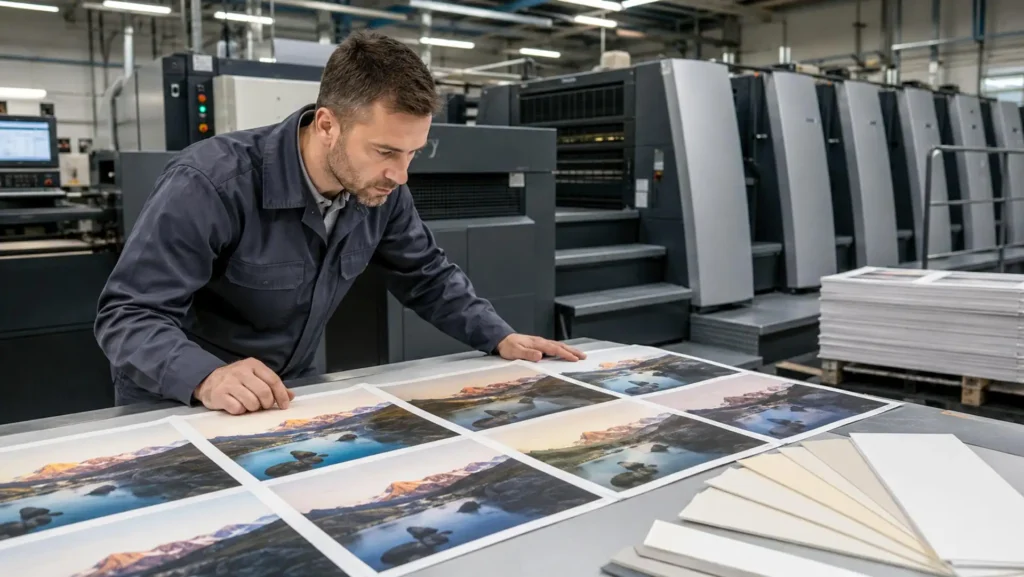
Press performance. On an offset printing press, the paper weight determines how the sheet feeds through rollers, how it responds to gripper pressure, and how it behaves in the delivery pile. A press calibrated for 90 GSM paper will produce different mechanical behaviour with 75 GSM stock. Getting the GSM match right reduces misfeeds, sheet flutter, and print defects.
Ink holdout and absorption. Heavier sheets with denser formation generally have better surface strength and can be surface-sized more effectively, improving ink holdout. But GSM alone does not determine ink holdout; the surface sizing process and fibre formation are equally important.
Opacity. Heavier sheets are generally more opaque, meaning printing on one side is less visible from the other. For double-sided printing and notebook manufacturing, opacity is critical and GSM is one factor that influences it.
Packaging performance. In packaging applications, GSM determines ream weight, which affects freight calculations, stacking resistance, and the structural contribution of the paper to the finished package.
| Paper Category | Typical GSM Range | Common Applications |
|---|---|---|
| Tissue / Facial | 12 to 25 GSM | Facial tissue, toilet tissue, napkins |
| Newsprint | 45 to 52 GSM | Newspaper printing |
| Copier / Office | 70 to 90 GSM | Office printing, photocopying |
| Writing Paper | 60 to 90 GSM | Notebooks, exercise books, letterhead |
| Offset Printing | 60 to 130 GSM | Brochures, books, commercial print |
| Bond Paper | 75 to 90 GSM | Letterhead, legal documents |
| Art Paper / Coated | 90 to 200 GSM | High-quality print, catalogues, magazines |
| Cover / Card Stock | 200 to 350 GSM | Business cards, covers, packaging inserts |
| Kraft / Packaging | 80 to 200 GSM | Corrugated liner, bag paper, wrapping |
| Saturating Kraft | 120 to 200 GSM | High-pressure laminates (HPL), decorative surfaces |
When placing a paper order or writing a procurement specification, GSM alone is not sufficient. Here is what a complete specification should include.
Nominal GSM and tolerance. State the target GSM and the acceptable range. For example: 80 GSM, plus or minus 3 GSM. This is important because paper manufacturing involves natural variation. A tolerance range tells the supplier what variation is acceptable for your application.
Application context. State what the paper will be used for. A supplier needs to know whether 80 GSM is going into an offset press, a digital printer, a notebook machine, or a packaging line, because the other properties required (surface sizing, smoothness, opacity, moisture content) differ by application even at the same GSM.
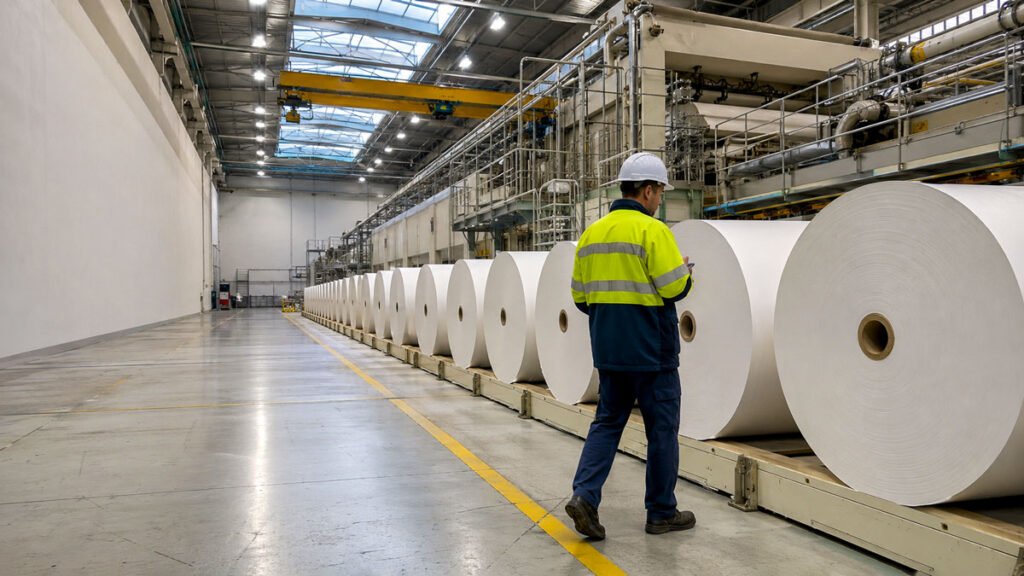
Sheet or reel supply. Specify whether you need sheeted paper at a given cut size or reels at a specified width and diameter. For high-volume production applications, reel supply is standard.
Additional test parameters. Depending on the application, specify burst strength (for packaging), opacity (for writing paper), brightness (for printing paper), smoothness (for high-quality print), and moisture content (for all machine-fed applications).
Buyers in the United States will be familiar with basis weight rather than GSM. Basis weight expresses paper weight in pounds per ream (500 sheets) of a specific reference sheet size, which varies by paper category. This makes basis weight values difficult to compare across paper types without knowing the reference sheet size used.
GSM is a universal measurement. It means the same thing regardless of paper type or country of origin. For international paper procurement, GSM is the cleaner and more reliable specification.
Conversion between basis weight and GSM is possible using standard conversion tables, but when sourcing from international suppliers, requesting GSM values directly avoids the ambiguity of basis weight comparisons.
KR Papers manufactures copier, printing, writing, kraft packaging, and saturating kraft papers across a range of GSM values from its manufacturing facility in Shahjahanpur, Uttar Pradesh, India. All production runs are tested for GSM tolerance, and batch test certificates are available for export orders.
We supply to buyers across Asia, the Middle East, Africa, and other international markets. If you are a paper importer, distributor, or procurement team looking for a reliable Indian paper manufacturer, we welcome your inquiry.
Get in touch: www.krpapers.com
KR Papers | Paper Manufacturer | Shahjahanpur, Uttar Pradesh, India | Est. 1995
At KR Papers, we craft premium, eco-friendly paper solutions that blend quality, innovation, and sustainability to meet diverse customer needs.

© 2026 KR Pulp and Papers Limited. All rights reserved.
WhatsApp us