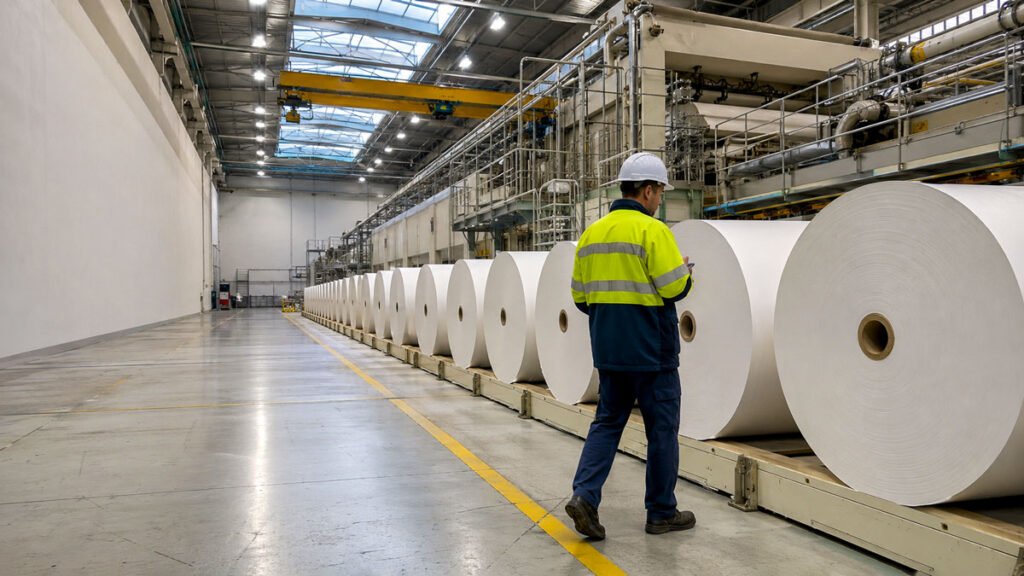
Why Manufacturing Consistency Is Becoming a Competitive Advantage in Paper Production

Whether you’re a wholesale distributor in Dubai, a paper importer in Lagos, or a procurement manager in Mumbai, bulk A4 paper sourcing is one of those decisions that looks straightforward until it isn’t. A wrong call on GSM, supplier reliability, or pricing terms can derail an entire quarter. Here’s how to get it right.
Most businesses treat copier paper as a commodity; something to reorder automatically from whichever distributor is cheapest that week. That approach works fine until a shipment arrives with the wrong GSM, inconsistent brightness, or paper that jams every third tray. Then it becomes a very expensive problem very quickly.
For importers and distributors, the stakes are even higher. You are not just buying paper for your own office. You are making a bet that what arrives in your warehouse will satisfy dozens or hundreds of downstream customers. A quality miss at the source cascades fast.
The global copier paper market is projected to reach USD 18.6 billion by 2035, growing at a steady 4.84% CAGR. A4 paper alone commands nearly 58% of that market. This is a category worth sourcing carefully.
GSM (grams per square metre) is the single most important specification when buying copier paper in bulk. It determines weight, thickness, opacity, feel, and performance in high-speed printers. And it directly drives your cost per ream.
Here is how to think about the three standard grades:
For bulk procurement, a common strategy is to stock 70 GSM for high-volume internal-use customers and 80 GSM for corporate and institutional buyers who care about print quality. The 75 GSM tier serves the broad middle market.
Tip: Always request ream samples at the exact GSM before committing to a container. A manufacturer’s stated 80 GSM and actual 80 GSM can differ by up to 2g, which matters at scale.
Brightness is the second-most important specification, and it is frequently overlooked. ISO brightness measures how much light a sheet reflects. The higher the number, the whiter the paper looks.
For most B2B copier paper, look for:
For wholesale buyers supplying offices, print shops, or institutions, consistently high brightness builds repeat business. A batch that comes in noticeably yellower than the last one creates customer complaints and returns, even if the GSM is identical.
Always request ISO brightness specifications in writing and ask manufacturers to back them with batch-level test reports.
For international bulk orders, two pricing terms dominate: FOB (Free On Board) and CIF (Cost, Insurance, Freight). Understanding the difference affects both your landed cost calculations and your risk exposure.
For most importers buying full 20- or 40-foot containers of A4 paper, FOB pricing from an Indian port (typically Mumbai, JNPT, or Chennai) gives the clearest cost picture. Add your freight quote, destination customs duties, and inland delivery to calculate your true landed cost per ream.
Market insight: Indian manufacturers quoting FOB from Mumbai to UAE ports are typically competitive against European and Southeast Asian suppliers even after freight, particularly in the 75-80 GSM range where Indian mills have invested heavily in quality consistency.
When shortlisting a bulk A4 paper supplier, price is the starting point, not the finish line. Here is what to dig deeper on:
Look for ISO 9001 quality management certification as a baseline. For buyers in regulated markets or those supplying corporate clients, ask about FSC (Forest Stewardship Council) certification, which signals responsible sourcing and is increasingly required by institutional buyers in Europe and the Gulf.
A manufacturer who quotes aggressively but is running at 100% capacity will create lead time problems the moment you need a reorder. Ask about current production capacity, typical lead times for a 20-foot container, and what buffer stock they maintain. A minimum 4-6 week lead time is standard; anything under that should prompt questions.
This is where many small mills fall short. Ask specifically: “Can you guarantee GSM and brightness within 2% across consecutive production runs?” Request test reports from at least three different production batches before placing your first large order. Inconsistency across batches is the number one complaint in wholesale paper distribution.
Any serious manufacturer will send samples before a bulk order. If they resist or charge significantly for samples, treat it as a red flag. A mill confident in its quality welcomes comparison testing.
Wholesale relationships break down most often over communication: slow responses to quality complaints, unclear documentation, delays in shipping confirmations. Before your first order, test response time. Send an enquiry and see how long it takes to get a detailed, accurate response.
The global A4 copier paper market is gradually realigning around Indian manufacturers, not as a compromise choice, but as a deliberate strategic decision by importers across the Gulf, Africa, Southeast Asia, and increasingly North America.
Indian mills have invested significantly in production technology over the past decade, with major players now running internationally certified, large-scale operations capable of delivering consistent quality at volumes that were previously only achievable from European or East Asian mills.
The cost advantage remains real: FOB pricing from India typically runs 15-25% lower than equivalent European product, and 8-15% below Southeast Asian alternatives at the 75-80 GSM tier. With improved logistics from Indian ports, the landed cost gap has widened in India’s favour over the past three years.
India’s paper industry now processes approximately 27 million metric tonnes annually, with a significant and growing share directed toward export markets. For bulk importers who need reliability, quality certification, and competitive FOB pricing in one place, the Indian mill landscape offers what was previously unavailable.
KR Papers supplies Kopier-branded A4 copier paper (70, 75 and 80 GSM) to wholesale importers and distributors across India, UAE, Gulf, Africa, and international markets. ISO certified, consistent quality, direct mill pricing. Contact us for samples and FOB quotes at krpapers.com
Bulk A4 paper sourcing done right is invisible: paper shows up on time, performs consistently, and customers never think twice about it. Sourcing done wrong shows up in complaints, returns, and lost distribution contracts. The difference comes down almost entirely to supplier selection and specification discipline upfront.
Take the time to get those right, and bulk paper procurement becomes one of the more predictable parts of a distributor’s business.
At KR Papers, we craft premium, eco-friendly paper solutions that blend quality, innovation, and sustainability to meet diverse customer needs.

© 2026 KR Pulp and Papers Limited. All rights reserved.
WhatsApp us